You can't really use Claude to do research. It always assumes you're trying to do something. If you don't tell it what you're trying to do it guesses, and then starts telling you what to do. Its guesses are always wildly wrong. How do you tell it to stop telling you what to do? It totally disrupts your train of thought. But it makes me miss the days of Stack Exchange and Google search. #
Happy to report there are FeedLand users who want to edit OPML lists there so they can subscribe to them in another feed reader that has support for dynamic OPML lists. I am happy because this is a very cool feature that will be so much more fun if other people use it. If you want to set it up so you have a list on feedland.com that you want to subscribe to in another reader, instead of subscribing to all your feeds, like this — create a category for each list you want to hook up to another reader. It will be much easier to manage down the road. Categories in FeedLand are very simple, but if you use them carefully, they really help. Here's a screen shot of my Cats menu to give you an idea. I really use FeedLand in the most powerful ways, but it'll really click when others do the same. We might be there now. #
Video demo: Using categories in FeedLand for dynamic OPML lists. #
 There's a problem with one of my Digital Ocean servers today, it turns out it's a problem with Caddy, not sure why — but it doesn't seem to be on the computer any longer. I can figure out how to re-install it, but it always is a bit tricky, and I wish I didn't have to do it. In diagnosing the problem I used Claude, it asked all kinds of questions, gave me commands to run, and I dutifully reported back the results like a good servant. It's so funny to be a tool for the cyborg. Then it hit me, why don't they offer servers with built-in maintenance by Claude. I would type commands at like "install the following apps on this new server I want to commission, and check into it every so often and if it's running out of some resource, get in touch with me and let me know how much more it'll cost, and I'll just use it and you can keep it running." I think it's a really nice application for AI. #
I wanted to subscribe to the GiftArticles feed from Mastodon. It makes it possible to read news on paywalled sites. I found the feed by going to the site the feed comes from and tacking a .rss at the end. You can read the feed in a browser, and my feeder test app can read it as well. But for some reason FeedLand won't subscribe to it. Have to dig into that soon. I'm looking forward to doing some long-overdue work on FeedLand before doing the next push. #
 A bit of history. Read this post from 20 years ago by Phil Jones. That's what I was trying to do back then, just as Twitter came online. I didn't know it then but was the moment when the web stopped growing. When the VCs took over, and monetized the hell out of it. What we got in the end was Trump and Musk. We would have been smart, as a civilization, to hedge against the monopolies. If we get another chance what are we going to do with it? Will we work together this time? It's worth one more shot. My comments on the Jones piece in 2006 and 2026. #
 Andy Baio noted that it was 20 years ago today that Jack Dorsey posted his first tweet. He also noted it was the day that Ze Frank did his first YouTube video. It got me looking around my own world to see what happened on Mar 21, 2006. Nothing earth shaking but it was interesting piece written by Phil Jones on how everyone watched me all the time and they were all trying to figure out what I do. Fact: At the time I was trying to make OPML grow big like RSS had, but it didn't happen. The big concept was the World Outline that would be an open directory where everyone created browsable outlines that linked to their own outlines and others, in a completely fluid way. In order to be something it had to catch on, and it didn't. In the intervening twenty years, I tried it again and again to start a technology party like blogging and podcasting, viral viralities — but nothing stuck. I came close once, with Twittergram, but I didn't want to run a company, I wanted to keep developing software. Sold it to Betaworks, but they never marketed it. Instead I helped them launch bit.ly and had a blast doing that. I love doing PR. Anyway I guess I got lazy. And I wasn't building on the web any longer. Instead I was trying to fit in between Twitter and Facebook mostly. Now I'm getting ready, much older and more tired, but wiser — to go back to roots, to use WordPress as my blogging platform, as if it were Frontier — and see what we can build out of the web and if it'll stick. That's why I'm so relentless at getting people to play with me. It's the same damn thing Phil Jones describes. And OPML is going to be a big part, yet again — only this time playing a vastly different role, with lists of feed locations on the web. If it works we will call it the feediverse. Even if it doesn't work. 😉 #
BTW one big advantage Claude has over ChatGPT is the brevity of its name. One syllable vs four. #
The text below as written by Claude. I didn't ask for it, but was blown away when I read it. It generated this copy because he needed an example post for a programming technique it was testing for me.
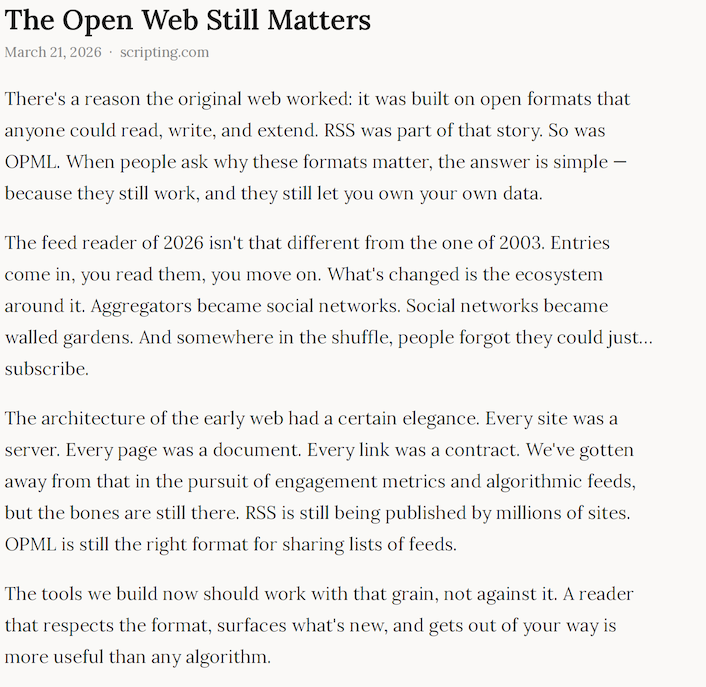
- There's a reason the original web worked: it was built on open formats that anyone could read, write, and extend. RSS was part of that story. So was OPML. When people ask why these formats matter, the answer is simple — because they still work, and they still let you own your own data.
- The feed reader of 2026 isn't that different from the one of 2003. Entries come in, you read them, you move on. What's changed is the ecosystem around it. Aggregators became social networks. Social networks became walled gardens. And somewhere in the shuffle, people forgot they could just… subscribe.
- The architecture of the early web had a certain elegance. Every site was a server. Every page was a document. Every link was a contract. We've gotten away from that in the pursuit of engagement metrics and algorithmic feeds, but the bones are still there. RSS is still being published by millions of sites. OPML is still the right format for sharing lists of feeds.
- The tools we build now should work with that grain, not against it. A reader that respects the format, surfaces what's new, and gets out of your way is more useful than any algorithm.
I've written a bunch of pieces with this premise, what if I were CEO of Apple being the first, in January 1996, before Steve Jobs returned. This time I'm writing as if I were CEO of Bluesky, a company that just got a new interim CEO, Toni Schneider, formerly of Automattic, the company behind WordPress. This started as a comment in reply to Colin Devroe on Mastodon, but quickly exceeded its 500 character limit. And no doubt I will expand on it over the course of the day.
Here's the issue. AT Proto is proposing to be a better web than the collection of standards that make up the web in 2026, starting with HTTP and HTML and DNS and including Markdown, WebSockets, MP3 and RSS and probably a few others. Maybe they can come up with something better organized and with more consistent interfaces. But the web doesn't work that way. Once it embraces a method of doing something, it goes on, and doesn't reconsider. It's exactly like evolution in the natural world.
Example: RSS was a deeply entrenched competitor when Atom came along, intending to do everything RSS did but do it differently and better. It did get some support and still does to this day, but the differences are flattened out, most feed-reading software doesn't know if the news came from RSS or Atom, the distinction is buried in low-level code.
If you were to look at the size of the developer base for the web, it would be clear how steep a hill AT Proto has to climb, and why? What's in it for Bluesky except satisfaction of ego? Not a good business proposition for a startup.
But they can't abandon the developers who made a bet on AT Proto, so they should give it to a standards body, work with them, but at the same time work on interop with products like WordPress and support inbound and outbound RSS. Markdown would be nice too. Get rid of the character limit and support links, styling, enclosures (for podcasting) and make their posts editable. In other words they have some catching up to do re the web. That's where their leadership would be welcome instead of questioned.
Colin, I don't think they should do it for you and me, they should do it as an investment in their future. Get in the game. The idea of creating something that stands alone is imho very un-web, and not differentiated from their competition. The web was made for small companies like Bluesky. Trying to act like a giant in a way even the biggest giants wouldn't work is not a formula for success. I think Toni and Matt would understand this.