 There's something incredibly funny about slapstick and farting. I was flipping channels the other day and came across an old WC Fields movie. I used to love them when I was a kid, but figured now, with so many many fancier forms of entertainment this wouldn't get to me, but I was laughing uncontrollably the whole way through. Later, I caught a SNL skit with a boss being surprised by her employees with a Happy Birthday celebration and started farting uncontrollably. They're indulging in body-humor thanks largely (I think) to Sarah Sherman whose whole comedy schtick is about disgusting things about the human body, esp her own. The boss was played by Ashley Padilla, another SNL superstar. Everything she does is funny, esp farting. Even now, rewatching the segment, I couldn't help but laughing loudly. Farts are funny. I have no idea why. #
Video demo of using Claude to write a Hello World app. #
We should teach everyone how to write software with the AI apps. If the language is too hard, make a new language that's easier. Eventually we'll come up with a fantastic language but you and I won't invent it, people who are newbies in 2026 will. Just like there was a whole new generation of software for PCs, graphic UIs and then for networking and the web. Try this out in Claude.
- Can you create a browser-based app that asks for the user's name in a nice dialog, not the one built into the browser, and then takes the name and displays it using only css styles in a simple animated fashion. It quits when I hit the Escape key. Give it to me in the form of an html file that i can download and run by double-clicking it in the Finder. Call the app hello.html.
I tried doing it but there was a bug in the result, and I had to say "Claude, 'delighted to make your acquaintance' appears but nothing else."
I did a video demo of this exercise.
The source code for my podcast builder app is open source. Of course I use my outliner to edit the OPML file for the podcast text and link in the enclosure. I recommend opening it in Drummer. To see how the atts work, click on the suitcase icon with the cursor on the main head for each episode. The new att is enclosure, which is the URL of the audio for the podcast. Drummer automatically fills in the length and type. #
 Podcast: Jen and I often exchange voicemails. Yesterday I sent one about how she, who is not a programmer, should try creating software with Claude or ChatGPT. I think the hardest part is figuring out how to get it to give you a file that you can run from your own desktop. But I explained that in the voicemail. Midway through I realized this a podcast, and checked with her if it would be okay and she was very emphatic that I should. You see NJ aside to being one of my best friends for life, is also a Natural Born Blogger or a person with maximum audacity. Her first instinct like mine is to share it and shut up. So that's what I'm doing. As usual I asked Claude to write the show notes. Hope you like it and thanks for listening! #
 I'd like an AI bot that could do this. I open my browser to a page on netflix.com. It scans the page, figures out what movies are there, then it searches metacritic for each and presents me a list of all shows with a rating above a certain score. I know the streamers don't want us to have this info (I don't really understand why) but I really want it. BTW, they say the Green Knight is fantastic. Got the tip from a NYT email, but even they didn't say what the rating was, or even what their own reviewer said. Had to do this thing manually. Do they have any user-oriented creative people in the mix anywhere in this system?? #
There's a conference in Vancouver this weekend for people who are developing apps for Bluesky. They have a protocol they are proud of called AT Proto. A sexy name, but imho it doesn't do anything that Twitter's API did 20 years ago. So why do people hope it'll make a difference for independent developers? I think they're believing because they want to believe in something, a magic potion that will make it easy for the web to overcome the power of the silos like Twitter, Facebook, Threads and Bluesky too.
I feel most sympathy for the developers who are using AT Proto to make writing tools that use the web as their prototype for what a good text editor would do. But they overlook the problem that Bluesky itself has most of the limits on writing that Twitter has, although Twitter is working slowly to get rid of the limits, presumably because when Elon Musk saw them he thought the limits were bullshit, as I do too and always have. It was a tragedy for the web, the day Twitter decided the web wasn't a good model for writers of "tweets" — they had to get rid of style, links, editing, enclosures and add a character limit so people couldn't use it for a longform writing platform.
The division created a problem that users have always wanted someone to solve — they don't want to have to copy/paste everything they write into five different editors because none of the silos can connect, much like the Apple TV series of the same name. Each silo is a world unto itself. And somehow, Bluesky which preserves the silo tradition, also claims to be a lover and supporter of the open web, truly outstanding VC hype.
Here's what Bluesky could do to turn me into a fan. Get rid of the limits. Then the people who have created writing tools for AT Proto will have a market to serve. We will of course convert WordLand to serve that newly enabled user base. Maybe that's what the writing tools devs are anticipating — the day when Bluesky decides that character limits have outlived their usefulness. And that links, the core innovation of the web, deserves to be loved, not hidden as if it's too much power for their users. When we can add an enclosure to help be sure that podcasting survives the latest BigSilo onslaught (it has survived all that came before, I have no reason to believe this time will be any different). They do also need to support inbound and outbound RSS so we can easily hook everything together. I will praise them individually and collectively. I would love to be wrong! I will sing a song in their name.
Rule #4 of Rules for Standards-Makers: "People choose to interop because it helps them find new users. If you have no users to offer, there won't be much interest in interop."
That's where Bluesky is stuck. If they want to keep their devs and to attract new ones, they have to give them access to all their users. All of them. And the only way to do that is to get rid of the limits, to make it the one twitter-like platform that can handle everyone else's tweets, and every writing tool ever written for the web before Twitter came along — ie Tumblr and WordPress, and everything anyone can think of that conforms to the standards that power the web — HTTP and HTML. I've suggested we settle on Markdown as the core writing functionality of these platforms.
The problem is that Bluesky doesn't have much of a business model if all their users can walk out the door every night. Not much monetizable value in that, but it would be good for the web, and for civilization.
Did some work on my RSS feed this morning.
- There was only one source:account element in my RSS feed and it was to a Twitter account I lost control of a few weeks ago, the account I had there since 2006, that at one time was in the top 10 accounts on Twitter. I changed the account to bullmancuso — one of my many testing sites on Twit, and added my Mastodon and Bluesky accounts. I will check the bullmancuso account every so often, but the masto and bluesky ones are several times daily. And the funny thing is that I have far more Bluesky and Mastodon accounts than Twitter accounts. Put that in your press release. 😉
- I updated the JSON version of the RSS feed, but noticed the Masto and Bluesky accounts (above) hadn't come through, and then on further investigation I realized that I hadn't been keeping it up to date for quite some time! The rule is every time something is added to the XML version I have to also add support for it in the JSON version. This is where Claude came in handy, it gave me a list of all the updates that were needed and I did them. We make a pretty good team imho. The two versions should be in sync now.
- A note on my JSONification of RSS. When I first did it in 2010, it was on a lark. I was tired of hearing how people didn't like XML so could I please switch. So I did and published it, and I think no one used it. The idea of a JSON version of RSS is in the air again, so I brought it up to date. I want to serve it with a different https-friendly address, but probably won't get to that today.
- The reason I wanted to work on this today because I have to add RSS-generating code to wpIdentity, so I needed to get warmed up on that part of the world.
- The new version of the daverss package is 0.6.15.
Yesterday I hatched an idea of a demo program that turns RSS 2.0 feeds with rssCloud into a WhatsApp-type communicator. I called it rss.network, and asked ChatGPT to draw a prototype.
How I did it. I pasted a screen shot into ChatGPT, and wrote:
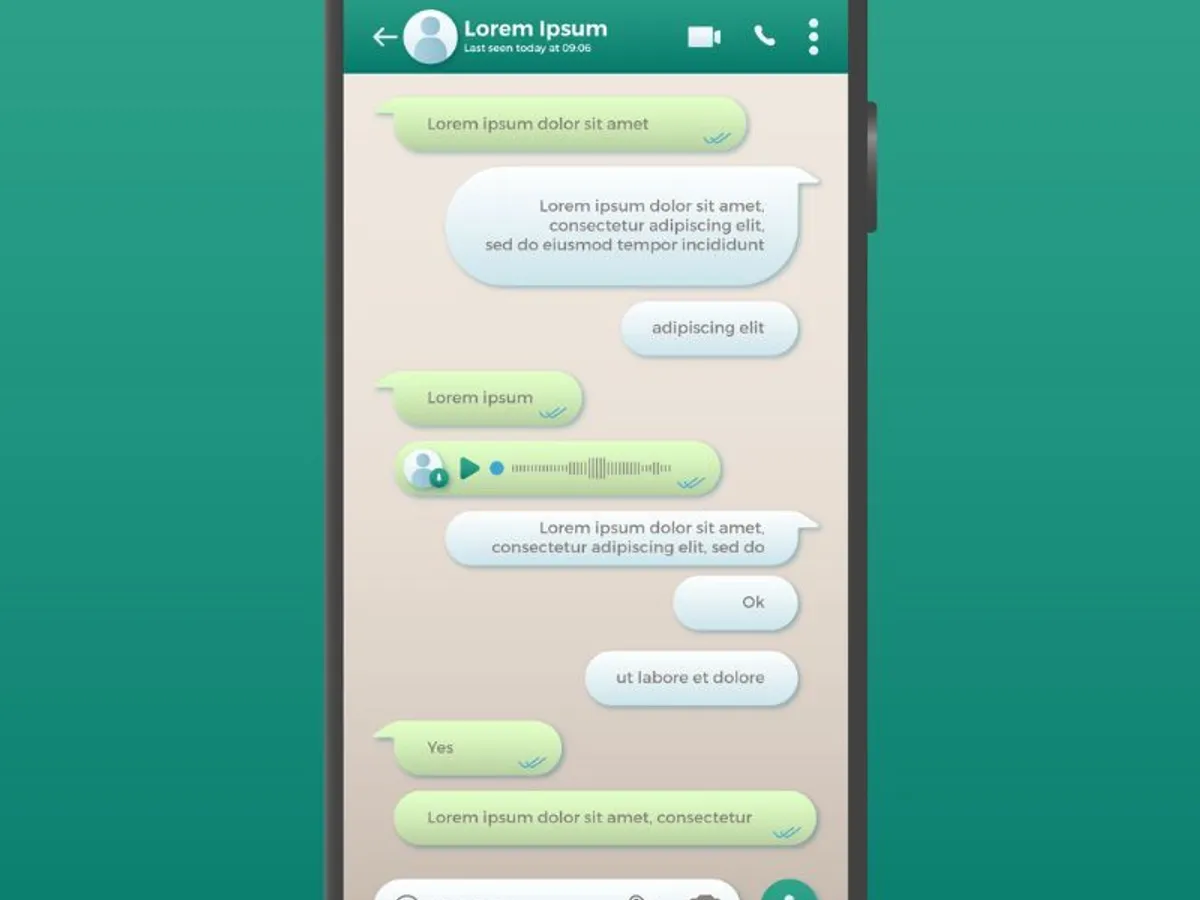
- "i want you to draw me something very specific, it's a chat screen like the image pasted above, but in the window it says rss.network. in the conversation two people are talking about how you can plug anything into the network now in 2028 because all an app needs to connect is RSS 2.0 support. it's a conversation between Harry and Sally. two or three messages back and forth. use your imagination."
It did exactly what I asked. The result was this image.
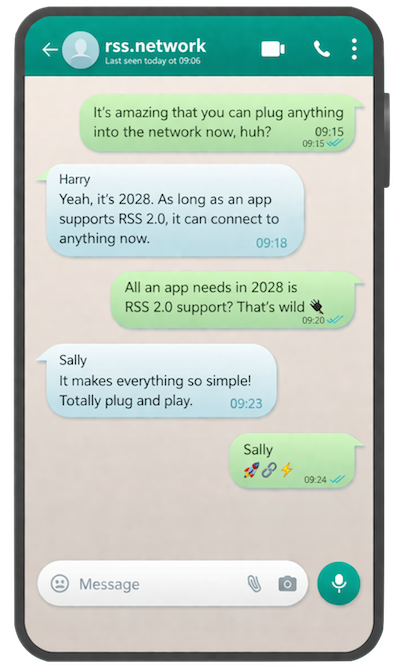
I bought the domain and turned it into a website in a few minutes with my outliner.
One day later (today)..
I wrote a description of the app (below) and gave it to Claude.ai, including the image that ChatGPT produced.
- "here's a screen shot of a mythical app that someday i'd like to develop. i have all the network stuff done, rssCloud servers, websockets software. but the user interface i don't have. i want something as simple as what you see here. a user has a name and each message is an RSS 2.0
- . the user's profile info is in the header part of the feed. so don't worry about that stuff, the messages will arrive automatically, all the app has to do is place them on a screen that looks like this. how to??"
It came back with a very usable design and implementation as a browser-based JavaScript app. I put it in the demo folder on my Digital Ocean server where you can run it by clicking on this link. It doesn't do anything, but it really would be easy to put it together with feeds, as we use them in FeedLand and WordPress. It's quite a team.
For now you'd use FeedLand to set it up for you and your friends, who would just use it. (I thought I needed an identity system, but what I really need to define a chat group is a subscription list, the standard stuff of RSS 2.0 systems.)
Should I finish this app tomorrow, or should I let someone else have the honor? 🙂
It's time to adjust our thinking about where the value is in software. Getting a new design ready to use in order to experiment, to try out a new idea, was a big bottleneck, now you just have to ask for it.
I may have found my calling in all this. I know how to design network user interfaces. The important thing is now to use open formats and protocols so we don't go through the same nightmare of silos we've dealt with since Twitter 1.0 (over 20 years now).
rss.network sounds nice. What would it be? #