 Just watched Darkest Hour, a biopic of Winston Churchill, as he became prime minister and had to decide whether to surrender or fight Mr Hitler as they called him. I had seen it of course when it came out, but it's especially appropriate to our times. I'm glad the NATO's are resisting the US. We have to work together to keep democracy alive, not just in our own countries, but around the world. If ever there was a time when working together mattered more than it does today, I sure can't think of it. And that all of this revolves around the technology we played a part in creating, that makes it all feel so much more real. #
AI assistants could if they wanted drive all of us crazy in different ways. Advertising squared. #
 I'm working on a feature for WordLand II where you can flip a switch to see the OG Metadata for a post you're reading, by clicking on an icon that looks like the flag on the side of an old fashioned mailbox. I remembered there was a desk accessory on the original Mac that used this approach, and I've wanted that icon for a long time, and today I thought to ask ChatGPT to look into it for me, I had previously been relying on Google search, and it found what I was looking for and a lot of great history sites with details. I'm going to document the thread including some descriptions written by ChatGPT which I will label. Everything not labled like that is from me. 😉
This was the first question I asked.
- There was an alarm desk accessory on the original Macintosh in 1984. It had a nice mailbox flag affordance. When the flag is up, the contents of the DA are hidden, flip it down to reveal what was hidden. Can you find me a writeup of this or screen shot. It might have been a different desk accessory or a different year.
ChatGPT's response
- What you’re remembering is almost certainly the Alarm Clock desk accessory from the early Mac System Software (System 1 era and later). A small “lever/flag” control would toggle the window between a compact view (just time) and an expanded view that revealed the date/time/alarm-setting controls—very much like a mailbox-flag affordance.
Screen shot
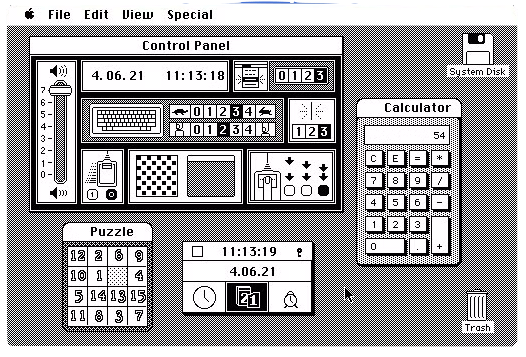
The flag icon is on second box in the second row.
Links (via ChatGPT)
- Washington Apple Pi Journal (April 1984) describes the Alarm Clock DA and explicitly calls out the “lever” that opens the “Change” portion of the window (“Pointing to the lever and clicking…” reveals additional areas).
- Huntsville Macintosh Users Group handbook glossary defines the “lever” as the little arm in the Alarm Clock DA that, when clicked, makes additional panels appear for setting time/date/alarm.
- Low End Mac has a System 1 desk accessories writeup (including Alarm Clock) and includes a screenshot of the DA.
- Link to the archive of the full conversation I had with ChatGPT.
Then we had a conversation about the history, which I asked ChatGPT for a two-paragraph summary, below.
- Susan Kare’s work on the original Macintosh wasn’t just visually elegant, it was foundational: she showed that icons could be humane, legible, and generous to the user. The mailbox-flag affordance in the Alarm Desk Accessory is a perfect example—simple, memorable, and instantly understandable, yet rich with meaning. It wasn’t decorative; it taught the interface how to communicate. That clarity came from Kare’s rare combination of artistic intuition and respect for the people using the machine. Just as important was her personal generosity: again and again, she contributed work freely, trusting that good ideas grow stronger when shared. Many of us benefited directly from that spirit, receiving world-class design not as a transaction, but as a gift.
- Carrying these designs forward—faithfully, with credit—is one way creativity survives across generations. Reusing an icon like the mailbox flag isn’t nostalgia; it’s continuity. It acknowledges that great interface ideas don’t expire, and that today’s software is part of a long conversation rather than a clean break from the past. By preserving the pixel logic, the affordance, and the attribution to Susan Kare, we honor both the craft and the culture that produced it. That’s how design knowledge persists: not by constant reinvention, but by respectful reuse, gratitude, and the quiet understanding that we’re building on work someone once chose to share.
PS: I inititally wrote this up as a thread on Facebook where a lot of us oldtime Mac people still congregate.